- Difficulty
- Beginner
- Build time
- 55-80 min
- Estimated cost
- $0-$5
- Age range
- 10-16
- Workspace
- A clear table about 90 cm wide
The finish line
What you will build
At least 18 of 20 sample trials land in the intended bins, with no coin leaving the side rails or becoming trapped at an opening.
Learning goals
- Identify how gravity-driven rolling coins produces diameter-separated collection bins.
- Construct and explain a rolling translation-to-sorted drop system.
- Measure how one opening width changes performance.
- Diagnose losses caused by edge catching and rolling friction.
Before you build
Materials, tools, and safety
Reuse-material cost: $0-$3 with reused materials. Supervision: Adult help recommended for sharp or heated tools.
Tools
- Ruler
- Pencil
- Scissors
- Low-temperature glue gun or tape
- Adult-operated craft knife for openings
Low-cost swaps
- Use clean shipping-box cardboard instead of buying sheets.
- Replace hot glue with strong tape and folded tabs.
- Use labeled cardboard circles instead of real currency so sizes can be exaggerated safely.
Project-specific safety
- An adult should handle craft knives and make difficult starter cuts.
- Let hot glue cool before pressing a joint or testing moving parts.
- Coins and small disks are choking hazards; use with adult supervision and store them after testing.
Orient the build
Place the build so gravity-driven rolling coins is on your left and diameter-separated collection bins is on your right. Call the side facing you the front, the far side the back, the tabletop the bottom, and the opposite face the top.
Build it
Step-by-step instructions
Step 1
Measure the samples
Record each coin or disk diameter in millimetres and sort the list smallest to largest.
Trace every sample on paper for reference.
Step 2
Build the sloped track
Raise one end of the 10 × 45 cm panel by about 6 cm.
Add side rails before cutting openings.
Step 3
Mark opening order
Lay out drop positions from smallest near the start to largest near the end.
Leave at least 4 cm of solid track between openings.
Builder checkpoint: After mark opening order, the first subassembly should stay aligned when handled gently.
Step 4
Cut and reinforce slots
Make each opening about 1 mm wider than its target sample.
Tape the cut edges smoothly without reducing width.
Watch for: If this stage binds or drifts, inspect track flex before adding more parts.
Step 5
Add catch bins
Place one labeled box directly below each opening.
Add dividers so dropped coins cannot bounce across bins.
Step 6
Run single-size trials
Release each sample from the same start line five times.
Record catch, miss, and jam outcomes.
Builder checkpoint: After run single-size trials, operate the build slowly and confirm that diameter-separated collection bins begins without binding.
Step 7
Correct one opening
Widen only the slot causing repeated catches in 0.5-1 mm steps.
Retest that sample and the next larger one.
Step 8
Run the mixed audit
Shuffle 20 samples and feed them one at a time.
Calculate correct-sort percentage.
Builder checkpoint: At the final checkpoint, At least 18 of 20 sample trials land in the intended bins, with no coin leaving the side rails or becoming trapped at an opening.
See the engineering
Why it works
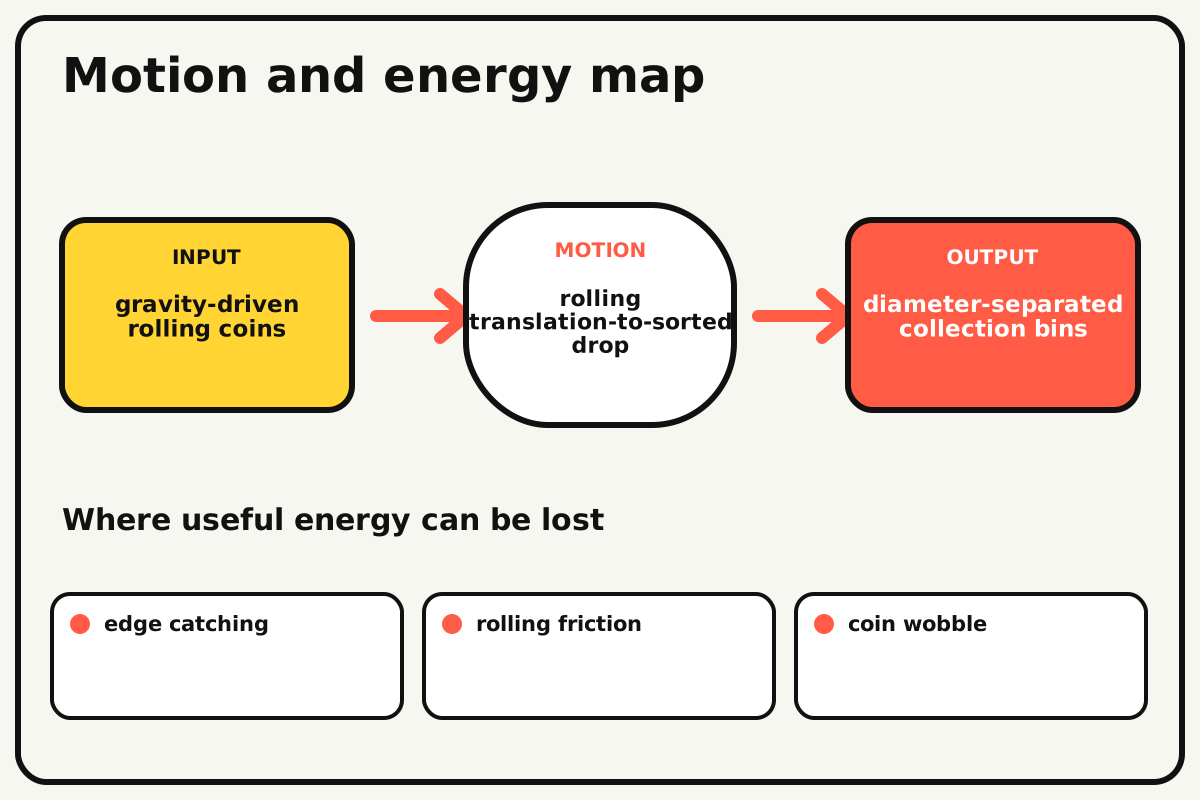
- Input
- gravity-driven rolling coins
- Output
- diameter-separated collection bins
- Motion
- rolling translation-to-sorted drop
- Energy losses
- edge catching, rolling friction, coin wobble, track flex
Why this works
Size-based geometric sorting
Openings arranged from smallest to largest allow each object to pass only when the opening exceeds its diameter plus a small clearance. Gravity moves every sample through the sequence.
Look for: Watch where each coin center crosses an opening and whether the rim catches before dropping.
Where the energy goes
Efficiency and losses
The ideal model leaves out edge catching, rolling friction, coin wobble, track flex. These effects turn some input energy into heat, sound, vibration, or unwanted motion, so measured performance will be lower than an ideal calculation.
Look for: Run the build slowly and locate the first place where edge catching becomes visible or audible.
Math bite
Choose opening clearance
Formula: opening width = object diameter + clearance
- Disk diameter = 24 mm
- Clearance = 1 mm
Substitute: opening width = 24 + 1 = 25 mm
Result: A 25 mm opening should pass the 24 mm disk.
The previous opening must remain smaller than 24 mm.
Wobble and rough edges require practical testing.
Make it behave
Test, troubleshoot, and tune
Controlled test
Start here: Release the smallest sample five times from one marked line.
Success looks like: At least 18 of 20 mixed trials reach the correct labeled bin.
Measure: Correct bins, jams, and pass-through errors.
Change: one opening width
Keep constant: track slope, samples, start line, rail height, bins, and release method
- exact diameter
- plus 1 mm
- plus 2 mm
| Symptom | Likely cause | Confirm it | Fix |
|---|---|---|---|
| A coin stops at a slot | Edge tape is rough or slope low | Roll the same coin without bins | Smooth the edge or increase slope slightly |
| A large coin falls early | An earlier opening is too wide | Measure the opening at three points | Narrow with a taped insert |
| Coins leave the track | Rails are low or release is angled | Roll from the marked guide | Raise rails and add a straight feeder |
| Coins bounce into wrong bins | Bins are shallow or unseparated | Drop samples by hand through slots | Deepen and divide the catch area |
Choose your tradeoff
Change opening width in small increments because an oversized early slot cannot distinguish nearby sizes. Increase slope only enough to prevent stalls; excessive speed increases bounce and wobble.
Keep experimenting
Try another version
Two-size sorter
Start with large cardboard disks that differ by 10 mm.
Close-size challenge
Sort disks that differ by only 2 mm.
Counting bins
Add manual tally sliders to record each size.
Build together
Classroom and access options
Classroom version
Teams can compare one opening width while keeping track slope, samples, start line, rail height, bins, and release method. Assign builder, tester, recorder, and explainer roles; have each team predict the result before collecting three trials.
Access adaptations
- Pre-cut repeated pieces and mark fold lines with high-contrast ink.
- Use large tabs, binder clips, and tape for easier one-handed assembly.
- Use large cardboard disks with tactile edge patterns for each diameter.
Reflect on the design
- How did one opening width change the measured result?
- Where did edge catching affect the build most strongly?
- What evidence shows that size-based geometric sorting explains the motion?
- Which change would improve diameter-separated collection bins without creating a new problem?
Glossary
- Size-based geometric sorting
- Openings arranged from smallest to largest allow each object to pass only when the opening exceeds its diameter plus a small clearance.
- Input
- The action or energy supplied to a system; here it is gravity-driven rolling coins.
- Output
- The useful response produced by a system; here it is diameter-separated collection bins.
- Efficiency
- The fraction of input energy that becomes useful output instead of friction, sound, heat, or unwanted motion.
Build your dreams
One build can start the next.
Share what you learned, change one variable, and help another builder understand what worked.
Explore more guidesSources and build notes
An original BrickLabClips cardboard machine with dimensionally specified construction.
- Cardboard design verification: Dimensions, fold allowances, repeated-motion joints, and likely load paths received an editorial geometry review.
Written and edited by BrickLabClips. Published 2026-07-22; updated 2026-07-22.