- Difficulty
- Intermediate
- Build time
- 60-90 min
- Estimated cost
- $0-$8
- Age range
- 10-17
- Workspace
- A clear table about 90 cm wide
The finish line
What you will build
The hand picks up, moves, and stacks three paper cups in under 90 seconds without direct contact from the operator's fingers.
Learning goals
- Identify how hand pulls on five control strings produces finger curling and cup grip.
- Construct and explain a linear tendon pull-to-curved finger motion system.
- Measure how thumb angle changes performance.
- Diagnose losses caused by string friction and joint stiffness.
Before you build
Materials, tools, and safety
Reuse-material cost: $0-$3 with reused materials. Supervision: Adult help recommended for sharp or heated tools.
Tools
- Ruler
- Pencil
- Scissors
- Timer or phone stopwatch
Low-cost swaps
- Use reclaimed paper and packaging while keeping material limits equal for every team.
- Replace metal test weights with labeled bags of coins or washers.
- Use drinking-straw finger segments threaded on string for an easier large-scale hand.
Project-specific safety
- Keep load and drop tests below shoulder height and away from faces.
- Clear the test zone before releasing moving objects or suspended loads.
- Use lightweight paper cups only, keep strings away from necks, and let an adult make narrow slots or holes.
Orient the build
Place the build so hand pulls on five control strings is on your left and finger curling and cup grip is on your right. Call the side facing you the front, the far side the back, the tabletop the bottom, and the opposite face the top.
Build it
Step-by-step instructions
Step 1
Trace the palm
Cut a broad palm and mark five finger roots with thumb opposite the fingers.
Round every edge.
Step 2
Segment the fingers
Score three fold joints on each strip without cutting through.
Tape the back of each joint as a hinge.
Step 3
Attach fingers
Tape each root to the palm and check the open shape.
Angle the thumb toward the center grip zone.
Builder checkpoint: After attach fingers, the first subassembly should stay aligned when handled gently.
Step 4
Route the tendons
Thread string from each fingertip through guides on the palm side.
Leave independent pull loops at the wrist.
Watch for: If this stage binds or drifts, inspect cardboard bending before adding more parts.
Step 5
Add return bands
Connect light elastic across the back of each joint.
Use only enough tension to reopen the finger.
Step 6
Fit the wrist support
Attach a broad strap and reinforce the tendon exit edge.
Confirm no string crosses skin.
Builder checkpoint: After fit the wrist support, operate the build slowly and confirm that finger curling and cup grip begins without binding.
Step 7
Practice one-cup grip
Approach an upright cup, pull evenly, lift 10 cm, and release.
Adjust thumb position before adding speed.
Step 8
Run the stack challenge
Move three cups into a pyramid and time three attempts.
Record drops, crushed cups, and completion time.
Builder checkpoint: At the final checkpoint, The hand picks up, moves, and stacks three paper cups in under 90 seconds without direct contact from the operator's fingers.
See the engineering
Why it works
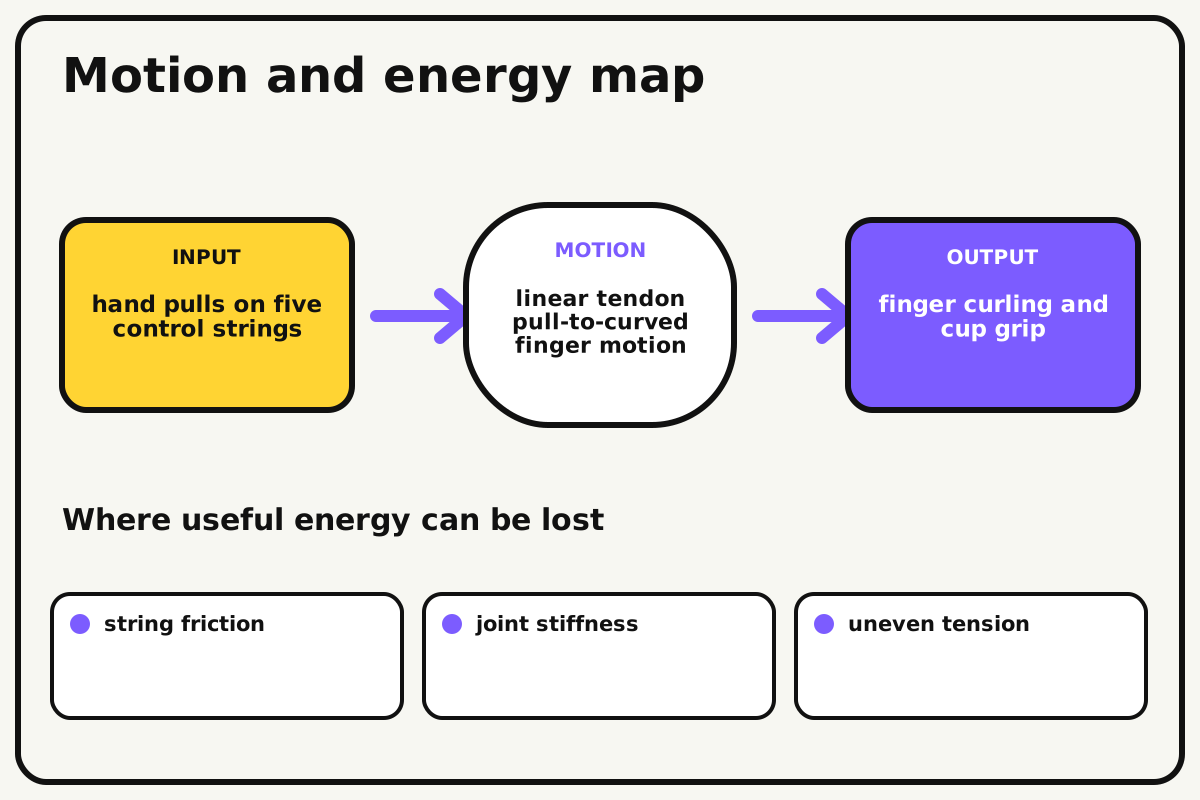
- Input
- hand pulls on five control strings
- Output
- finger curling and cup grip
- Motion
- linear tendon pull-to-curved finger motion
- Energy losses
- string friction, joint stiffness, uneven tension, cardboard bending
Why this works
Tendon-driven motion
A string routed along the inside of a segmented finger shortens that side when pulled, causing the flexible joints to curl around the cup.
Look for: Pull one tendon slowly and identify which joint moves first and where string rubs against cardboard.
Where the energy goes
Efficiency and losses
The ideal model leaves out string friction, joint stiffness, uneven tension, cardboard bending. These effects turn some input energy into heat, sound, vibration, or unwanted motion, so measured performance will be lower than an ideal calculation.
Look for: Run the build slowly and locate the first place where string friction becomes visible or audible.
Math bite
Calculate success rate
Formula: success rate = completed stacks / attempts × 100%
- Completed stacks = 2
- Attempts = 3
Substitute: success rate = 2 / 3 × 100% = 66.7%
Result: Two of three attempts succeeded.
More practice or grip tuning may raise reliability.
Three attempts are a small sample.
Make it behave
Test, troubleshoot, and tune
Controlled test
Start here: Lift one empty cup 10 cm before attempting a stack.
Success looks like: The device stacks three cups in under 90 seconds without direct hand contact.
Measure: Completion time, dropped cups, tendon pulls, and cup deformation.
Change: thumb angle
Keep constant: hand body, strings, cups, operator, course, and starting arrangement
- thumb straight
- thumb angled 20°
- thumb angled 35°
| Symptom | Likely cause | Confirm it | Fix |
|---|---|---|---|
| The cup slips | Thumb opposition or tendon tension is low | Hold the cup without lifting | Angle the thumb and shorten slack |
| Fingers stay closed | Return bands are weak or strings bind | Release handles one at a time | Open guides and replace bands |
| One finger curls early | Tendon lengths differ | Mark strings at full-open position | Equalize pull loops |
| The palm bends | Load path is not reinforced | Grip one cup and view the palm edge | Laminate the palm and add ribs |
Choose your tradeoff
Reliable cup contact matters more than maximum squeeze. Stronger tendons can crush cups and overload joints, while too much return tension makes the controls hard to pull.
Keep experimenting
Try another version
Two-finger gripper
Use a thumb and one wide finger.
Six-cup stack
Optimize controls for a taller pyramid.
Single-handle control
Design a tendon comb that closes fingers in sequence.
Build together
Classroom and access options
Classroom version
Teams can compare thumb angle while keeping hand body, strings, cups, operator, course, and starting arrangement. Assign builder, tester, recorder, and explainer roles; have each team predict the result before collecting three trials.
Access adaptations
- Assign varied roles such as designer, builder, tester, recorder, and presenter.
- Provide pre-measured materials and a visual checklist when helpful.
- Combine finger strings into one large handle or assign two operators to pull grouped tendons.
Reflect on the design
- How did thumb angle change the measured result?
- Where did string friction affect the build most strongly?
- What evidence shows that tendon-driven motion explains the motion?
- Which change would improve finger curling and cup grip without creating a new problem?
Glossary
- Tendon-driven motion
- A string routed along the inside of a segmented finger shortens that side when pulled, causing the flexible joints to curl around the cup.
- Input
- The action or energy supplied to a system; here it is hand pulls on five control strings.
- Output
- The useful response produced by a system; here it is finger curling and cup grip.
- Efficiency
- The fraction of input energy that becomes useful output instead of friction, sound, heat, or unwanted motion.
Build your dreams
One build can start the next.
Share what you learned, change one variable, and help another builder understand what worked.
Explore more guidesSources and build notes
A common classroom engineering challenge implemented with original constraints, diagrams, and measurement guidance.
- Classroom challenge basis: A controlled-variable engineering activity with original constraints, scoring ideas, and measurement guidance.
Written and edited by BrickLabClips. Published 2026-07-22; updated 2026-07-22.