
- Difficulty
- Beginner
- Build time
- 40-60 min
- Estimated cost
- $0-$10
- Age range
- 10-16
- Workspace
- A clear table about 90 cm wide
The finish line
What you will build
The platform vibrates visibly at hand-crank speed, remains attached to its base, and shows a clear increase in motion when the offset radius grows.
Learning goals
- Identify how hand rotation of an off-center mass produces repeating platform vibration.
- Construct and explain a rotary-to-oscillating frame motion system.
- Measure how the mass offset radius changes performance.
- Diagnose losses caused by bearing friction and base damping.
Before you build
Materials, tools, and safety
Reuse-material cost: $0-$3 with reused materials. Supervision: Adult help recommended for sharp or heated tools.
Tools
- Ruler
- Removable tape for motion marks
Low-cost swaps
- Use equivalent brick-compatible parts from any kit.
- Use cardboard beams and straw bearings for a larger demonstration model.
- Use a clothespin or binder clip as the adjustable mass on a hand-turned cardboard disk.
Project-specific safety
- Keep fingers, hair, and loose sleeves clear of moving parts.
- Turn the mechanism by hand; do not attach a high-speed motor.
- Keep speeds low and secure every mass with two independent connections before turning.
Orient the build
Place the build so hand rotation of an off-center mass is on your left and repeating platform vibration is on your right. Call the side facing you the front, the far side the back, the tabletop the bottom, and the opposite face the top.
Build it
Step-by-step instructions
Step 1
Build the low-speed bearing
Support one axle in a rigid frame with a comfortable crank.
Confirm it spins freely before adding mass.
Step 2
Create the moving platform
Build a light rectangular platform above four flexible supports.
Keep support stiffness similar at every corner.
Step 3
Mount the shaker frame
Attach the axle frame firmly to the platform center.
Check that no rotating part can strike a support.
Builder checkpoint: After mount the shaker frame, the first subassembly should stay aligned when handled gently.
Step 4
Add a small offset mass
Secure one mass close to the axle using two connections.
Rotate slowly and inspect clearance through 360 degrees.
Watch for: If this stage binds or drifts, inspect air drag before adding more parts.
Step 5
Add a motion pointer
Tape a long paper strip to one platform edge beside a fixed scale.
Set the pointer near zero while stopped.
Step 6
Run the first trial
Turn at one rotation per second for ten seconds.
Record approximate pointer range and any loose sounds.
Builder checkpoint: After run the first trial, operate the build slowly and confirm that repeating platform vibration begins without binding.
Step 7
Increase eccentricity
Move the same mass farther from the axle without changing anything else.
Repeat at the same counted rotation rate.
Step 8
Compare damping
Place soft foam under the base, then a firmer pad.
Observe how support material changes transmitted vibration.
Builder checkpoint: At the final checkpoint, The platform vibrates visibly at hand-crank speed, remains attached to its base, and shows a clear increase in motion when the offset radius grows.
See the engineering
Why it works
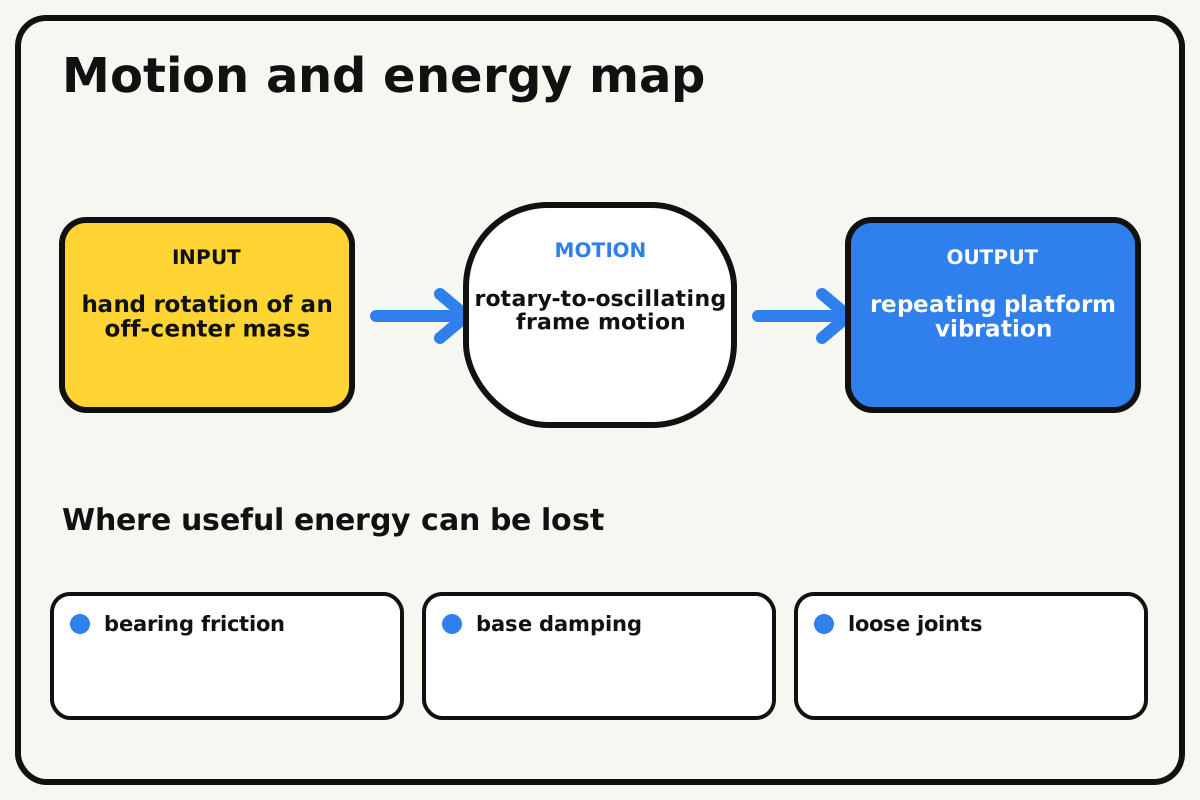
- Input
- hand rotation of an off-center mass
- Output
- repeating platform vibration
- Motion
- rotary-to-oscillating frame motion
- Energy losses
- bearing friction, base damping, loose joints, air drag
Why this works
Rotating imbalance
An off-center mass requires inward centripetal force as it circles. The frame supplies that force and receives an equal changing reaction, producing vibration whose intensity grows with mass, radius, and speed.
Look for: Tape a paper pointer to the platform and compare its blur or travel at two offset radii.
Where the energy goes
Efficiency and losses
The ideal model leaves out bearing friction, base damping, loose joints, air drag. These effects turn some input energy into heat, sound, vibration, or unwanted motion, so measured performance will be lower than an ideal calculation.
Look for: Run the build slowly and locate the first place where bearing friction becomes visible or audible.
Math bite
Compare imbalance force
Formula: force is proportional to m × r × ω²
- Mass m stays constant
- Radius changes from 10 mm to 20 mm
Substitute: force ratio = 20/10 = 2
Result: Doubling radius doubles the ideal imbalance force at the same speed.
Speed has an even larger squared effect, so hand speed must stay controlled.
Flexible frames and damping change the measured motion.
Make it behave
Test, troubleshoot, and tune
Controlled test
Start here: Turn the smallest offset at one revolution per second for ten seconds.
Success looks like: The platform vibrates without any mass, axle, or support loosening.
Measure: Pointer range and rotations in ten seconds.
Change: the mass offset radius
Keep constant: mass, crank rate, platform, supports, and test duration
- 10 mm offset
- 20 mm offset
- 20 mm offset with softer pads
| Symptom | Likely cause | Confirm it | Fix |
|---|---|---|---|
| The platform barely moves | Offset mass or radius is too small | Compare pointer range with no mass | Increase radius slightly while keeping speed low |
| The motion is unpredictable | A support is loose or much softer | Press each corner while stopped | Match and secure all four supports |
| The crank becomes hard to turn | The mass or disk rubs the frame | Rotate one cycle and inspect clearance | Reposition the mass and widen clearance |
| A mass shifts | Its attachment is not redundant | Mark its starting position before each trial | Stop and add a second secure connection |
Choose your tradeoff
Increase only one of mass, radius, or speed at a time. Radius is safer to compare at low hand speed; speed increases force rapidly and should remain deliberately limited.
Keep experimenting
Try another version
Sound indicator
Let the paper pointer tap a card once per vibration.
Balanced pair
Add an equal mass opposite the first and compare vibration.
Frequency sweep
Count platform cycles at several known crank rates and graph amplitude.
Build together
Classroom and access options
Classroom version
Teams can compare the mass offset radius while keeping mass, crank rate, platform, supports, and test duration. Assign builder, tester, recorder, and explainer roles; have each team predict the result before collecting three trials.
Access adaptations
- Use high-contrast tape to distinguish input and output parts.
- Replace a small crank with a wider handle for an easier grip.
- Attach a paper strip that taps a card so vibration can be heard as well as seen.
Reflect on the design
- How did the mass offset radius change the measured result?
- Where did bearing friction affect the build most strongly?
- What evidence shows that rotating imbalance explains the motion?
- Which change would improve repeating platform vibration without creating a new problem?
Glossary
- Rotating imbalance
- An off-center mass requires inward centripetal force as it circles.
- Input
- The action or energy supplied to a system; here it is hand rotation of an off-center mass.
- Output
- The useful response produced by a system; here it is repeating platform vibration.
- Efficiency
- The fraction of input energy that becomes useful output instead of friction, sound, heat, or unwanted motion.
Build your dreams
One build can start the next.
Share what you learned, change one variable, and help another builder understand what worked.
Explore more guidesSources and build notes
An original BrickLabClips interpretation of a standard mechanical mechanism.
- Mechanism verification: Standard kinematics were checked for motion direction, constraint, clearance, and likely friction points.
Written and edited by BrickLabClips. Published 2026-07-22; updated 2026-07-22.