- Difficulty
- Intermediate
- Build time
- 60-90 min
- Estimated cost
- $0-$18
- Age range
- 11-17
- Workspace
- A clear table about 90 cm wide
The finish line
What you will build
The winch lifts a 50-gram test cup without tooth skipping, holds position when the crank is released, and winds string evenly across the drum.
Learning goals
- Identify how rotation of a horizontal worm shaft produces slow rotation of a lifting drum.
- Construct and explain a rotary-to-rotary at right angles system.
- Measure how the test mass in the cup changes performance.
- Diagnose losses caused by sliding tooth friction and drum bearing friction.
Before you build
Materials, tools, and safety
Reuse-material cost: Usually under $5 with an existing kit. Supervision: Adult help recommended for sharp or heated tools.
Tools
- Ruler
- Removable tape for motion marks
Low-cost swaps
- Use equivalent brick-compatible parts from any kit.
- Use cardboard beams and straw bearings for a larger demonstration model.
- Use a threaded rod and matching gear only when their pitch is designed to mesh smoothly.
Project-specific safety
- Keep fingers, hair, and loose sleeves clear of moving parts.
- Turn the mechanism by hand; do not attach a high-speed motor.
- Lift only small classroom masses over a tray; this model is not for lifting people, pets, or valuable objects.
Orient the build
Place the build so rotation of a horizontal worm shaft is on your left and slow rotation of a lifting drum is on your right. Call the side facing you the front, the far side the back, the tabletop the bottom, and the opposite face the top.
Build it
Step-by-step instructions
Step 1
Build a wide base
Brace two parallel rails with cross members wider than the worm wheel.
Reserve one side for the hanging string path.
Step 2
Support the worm shaft
Mount the worm horizontally in two low-friction bearings.
Add a crank outside the frame and collars inside.
Step 3
Mesh the worm wheel
Position its axle perpendicular to the worm and adjust height until teeth engage evenly.
Turn the worm by hand before fixing supports.
Builder checkpoint: After mesh the worm wheel, the first subassembly should stay aligned when handled gently.
Step 4
Add the drum
Lock a round drum to the wheel axle without letting it rub the frame.
Place the drum beside the wheel so string cannot enter the teeth.
Watch for: If this stage binds or drifts, inspect frame spreading before adding more parts.
Step 5
Brace the wheel bearings
Join both bearing walls above and below the axle.
Confirm the worm cannot push the wheel support sideways.
Step 6
Tie and route the string
Anchor string through a drum hole and wind three neat turns.
Route the free end over the frame edge without a sharp bend.
Builder checkpoint: After tie and route the string, operate the build slowly and confirm that slow rotation of a lifting drum begins without binding.
Step 7
Lift an empty cup
Turn the crank slowly and guide the string into adjacent wraps.
Stop if wraps cross or the drum walks sideways.
Step 8
Add measured load
Increase the cup mass in 10-gram steps up to 50 grams.
Release the crank after each lift and record whether the load holds.
Builder checkpoint: At the final checkpoint, The winch lifts a 50-gram test cup without tooth skipping, holds position when the crank is released, and winds string evenly across the drum.
See the engineering
Why it works
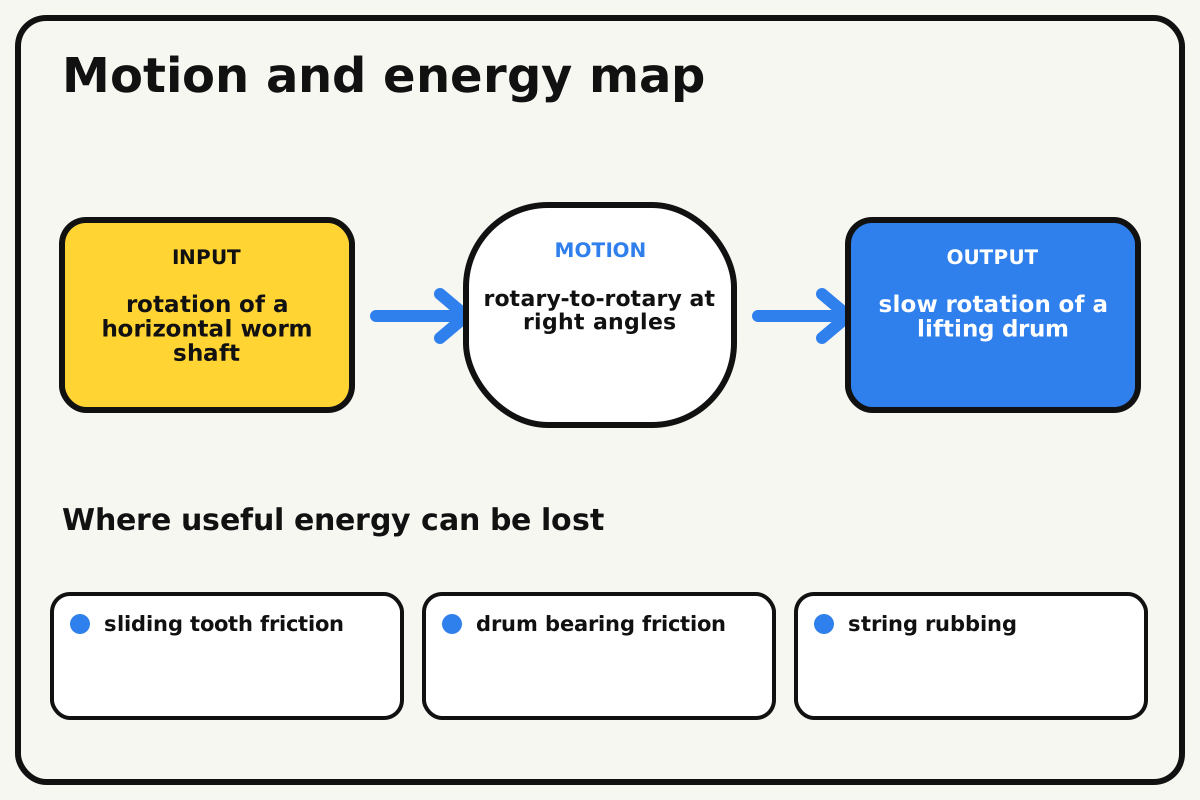
- Input
- rotation of a horizontal worm shaft
- Output
- slow rotation of a lifting drum
- Motion
- rotary-to-rotary at right angles
- Energy losses
- sliding tooth friction, drum bearing friction, string rubbing, frame spreading
Why this works
Worm-drive reduction
A single-start worm advances the wheel by about one tooth per worm revolution. The steep reduction multiplies ideal torque, while sliding friction can resist the wheel from turning the worm backward.
Look for: Release the crank after lifting a light cup and watch whether the output holds instead of unwinding.
Where the energy goes
Efficiency and losses
The ideal model leaves out sliding tooth friction, drum bearing friction, string rubbing, frame spreading. These effects turn some input energy into heat, sound, vibration, or unwanted motion, so measured performance will be lower than an ideal calculation.
Look for: Run the build slowly and locate the first place where sliding tooth friction becomes visible or audible.
Math bite
Estimate the worm ratio
Formula: ideal ratio = wheel teeth / worm starts
- Wheel = 24 teeth
- Worm = 1 start
Substitute: ratio = 24/1 = 24
Result: Twenty-four worm turns produce about one wheel turn.
Ideal drum torque is multiplied by 24 before friction losses.
The model assumes a single-start worm and ignores substantial sliding friction.
Make it behave
Test, troubleshoot, and tune
Controlled test
Start here: Lift an empty cup 10 cm at a slow steady crank rate.
Success looks like: String winds evenly, the cup rises without jerks, and the drum holds after release.
Measure: Crank turns, lift height, time, and maximum held mass up to 50 grams.
Change: the test mass in the cup
Keep constant: drum diameter, string, frame, lift height, and crank rate
- empty cup
- 25-gram cup
- 50-gram cup
| Symptom | Likely cause | Confirm it | Fix |
|---|---|---|---|
| The worm climbs over the wheel | The wheel support spreads or mesh is shallow | Hold the drum and watch center distance | Brace the bearings and deepen mesh slightly |
| The crank is extremely hard to turn | Mesh is too tight or collars squeeze bearings | Remove string load and test each shaft | Add running clearance and realign shafts |
| String piles at one side | The drum is tilted or wraps are crossing | Watch the first three unloaded turns | Square the drum and guide string into adjacent wraps |
| The cup falls when released | The drive back-drives under this geometry and load | Test with a lighter mass over a tray | Reduce load and add a separate ratchet or brake |
Choose your tradeoff
A tighter worm mesh can reduce backlash but sharply raises sliding friction. Prioritize smooth hand operation and add a separate holding device if the mechanism back-drives instead of assuming every worm pair is self-locking.
Keep experimenting
Try another version
Pointer output
Replace the string load with a paper dial pointer.
Drum-size comparison
Test how a smaller drum changes lift force and distance per turn.
Efficiency estimate
Compare input work at the crank with the cup's gain in gravitational potential energy.
Build together
Classroom and access options
Classroom version
Teams can compare the test mass in the cup while keeping drum diameter, string, frame, lift height, and crank rate. Assign builder, tester, recorder, and explainer roles; have each team predict the result before collecting three trials.
Access adaptations
- Use high-contrast tape to distinguish input and output parts.
- Replace a small crank with a wider handle for an easier grip.
- Fit a long crank arm and large knob so the many required turns remain comfortable.
Reflect on the design
- How did the test mass in the cup change the measured result?
- Where did sliding tooth friction affect the build most strongly?
- What evidence shows that worm-drive reduction explains the motion?
- Which change would improve slow rotation of a lifting drum without creating a new problem?
Glossary
- Worm-drive reduction
- A single-start worm advances the wheel by about one tooth per worm revolution.
- Input
- The action or energy supplied to a system; here it is rotation of a horizontal worm shaft.
- Output
- The useful response produced by a system; here it is slow rotation of a lifting drum.
- Efficiency
- The fraction of input energy that becomes useful output instead of friction, sound, heat, or unwanted motion.
Build your dreams
One build can start the next.
Share what you learned, change one variable, and help another builder understand what worked.
Explore more guidesSources and build notes
An original BrickLabClips interpretation of a standard mechanical mechanism.
- Mechanism verification: Standard kinematics were checked for motion direction, constraint, clearance, and likely friction points.
Written and edited by BrickLabClips. Published 2026-07-22; updated 2026-07-22.