
- Difficulty
- Intermediate
- Build time
- 90-140 min
- Estimated cost
- $0-$8
- Age range
- 11-17
- Workspace
- A clear table about 90 cm wide
The finish line
What you will build
The elevator lifts ten consecutive marbles at least 25 cm, releases them into the top track, and returns empty carriers without jamming.
Learning goals
- Identify how hand-crank rotation produces repeated upward marble transport.
- Construct and explain a rotary input-to-cyclic vertical lift system.
- Measure how the top release-ramp angle changes performance.
- Diagnose losses caused by carrier rubbing and axle friction.
Before you build
Materials, tools, and safety
Reuse-material cost: $0-$3 with reused materials. Supervision: Adult help recommended for sharp or heated tools.
Tools
- Ruler
- Pencil
- Scissors
- Low-temperature glue gun or tape
- Skewers or dowels
- Adult-operated craft knife
Low-cost swaps
- Use clean shipping-box cardboard instead of buying sheets.
- Replace hot glue with strong tape and folded tabs.
- Mount cups around one large hand-cranked wheel instead of building a chain loop.
Project-specific safety
- An adult should handle craft knives and make difficult starter cuts.
- Let hot glue cool before pressing a joint or testing moving parts.
- Marbles are choking hazards; contain both the loading and unloading areas and supervise younger builders.
Orient the build
Place the build so hand-crank rotation is on your left and repeated upward marble transport is on your right. Call the side facing you the front, the far side the back, the tabletop the bottom, and the opposite face the top.
Build it
Step-by-step instructions
Step 1
Build the tall frame
Join two side panels with top, bottom, and diagonal braces.
Keep the base wide enough to resist tipping.
Step 2
Make the drive wheels
Laminate matching circles and pierce centered axle holes.
Add rims or teeth that keep the loop aligned.
Step 3
Install top and bottom axles
Mount both axles level and parallel, with the crank on the lower drive axle.
Check full rotation before adding carriers.
Builder checkpoint: After install top and bottom axles, the first subassembly should stay aligned when handled gently.
Step 4
Prepare equal carriers
Fold cups slightly larger than one marble and reinforce their attachment tabs.
Test each by hand at the top release angle.
Watch for: If this stage binds or drifts, inspect frame flex before adding more parts.
Step 5
Build and fit the loop
Connect string or paper chain around both wheels and space carriers evenly.
Set moderate tension without bending axles.
Step 6
Add the loading chute
Guide one marble into the lowest carrier while blocking a second marble.
Use a small queue gate.
Builder checkpoint: After add the loading chute, operate the build slowly and confirm that repeated upward marble transport begins without binding.
Step 7
Add the top release
Build a ramp that catches the marble when the carrier tips or passes over the top.
Add side walls to prevent bounce-out.
Step 8
Run ten transfers
Crank at one turn every two seconds and feed one marble at a time.
Record missed loads, drops, and successful releases.
Builder checkpoint: At the final checkpoint, The elevator lifts ten consecutive marbles at least 25 cm, releases them into the top track, and returns empty carriers without jamming.
See the engineering
Why it works
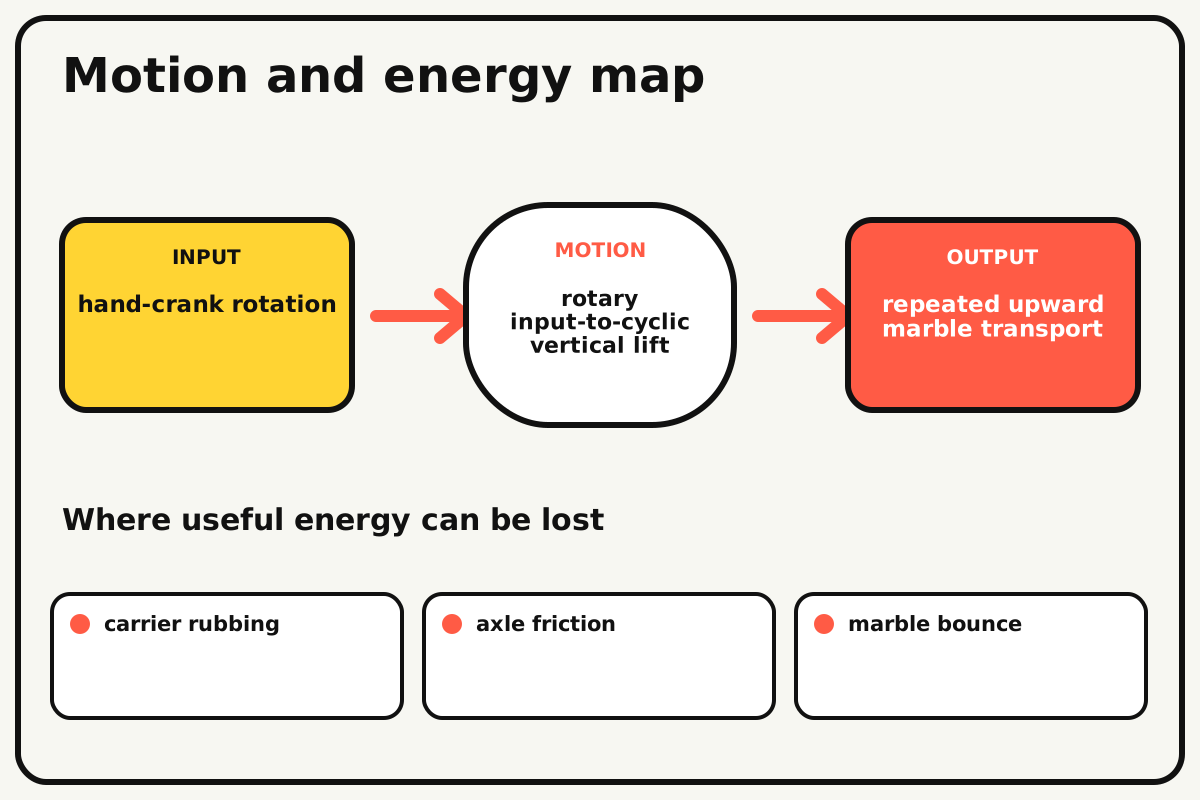
- Input
- hand-crank rotation
- Output
- repeated upward marble transport
- Motion
- rotary input-to-cyclic vertical lift
- Energy losses
- carrier rubbing, axle friction, marble bounce, frame flex
Why this works
Cyclic material handling
Carriers move through loading, lifting, unloading, and return phases. Reliable timing requires each carrier to arrive aligned with the inlet and tip or clear the marble at the outlet.
Look for: Mark one carrier and name each phase during a complete crank cycle.
Where the energy goes
Efficiency and losses
The ideal model leaves out carrier rubbing, axle friction, marble bounce, frame flex. These effects turn some input energy into heat, sound, vibration, or unwanted motion, so measured performance will be lower than an ideal calculation.
Look for: Run the build slowly and locate the first place where carrier rubbing becomes visible or audible.
Math bite
Calculate lifting work
Formula: work = mass × g × height
- Marble mass = 0.005 kg
- Height = 0.25 m
- g = 9.8 m/s²
Substitute: work = 0.005 × 9.8 × 0.25 = 0.0123 J
Result: At least 0.012 joules of useful work lifts one marble.
The crank supplies more because of friction and carrier motion.
This ignores the mass of the carrier and loop.
Make it behave
Test, troubleshoot, and tune
Controlled test
Start here: Run one empty carrier through a complete cycle by hand.
Success looks like: Ten marbles load, rise 25 cm, and release with at least eight successful transfers.
Measure: Successful lifts, drops, jams, and crank turns.
Change: the top release-ramp angle
Keep constant: marbles, carrier spacing, crank rate, frame, inlet, and lift height
- shallow release
- middle release
- steeper release
| Symptom | Likely cause | Confirm it | Fix |
|---|---|---|---|
| Carriers tip sideways | Loop is loose or attachments differ | Run empty and view from front | Equalize tabs and add side guides |
| Two marbles enter one cup | The inlet lacks a singulating gate | Feed a five-marble queue slowly | Narrow the gate to one diameter |
| Marbles miss the top ramp | Release point or walls are misaligned | Turn one carrier slowly over top | Move the ramp and raise walls |
| The frame bows | Axle tension is excessive | Remove the loop and compare alignment | Reduce tension and add diagonal braces |
Choose your tradeoff
Reliable loading and release matter more than speed. Adjust one station while turning slowly; more loop tension may reduce sag but increases axle friction and frame load.
Keep experimenting
Try another version
Single-wheel scoop
Mount cups around one large wheel.
Automatic queue gate
Let each carrier release exactly one waiting marble.
Closed-loop run
Connect the outlet to a marble run returning to the inlet.
Build together
Classroom and access options
Classroom version
Teams can compare the top release-ramp angle while keeping marbles, carrier spacing, crank rate, frame, inlet, and lift height. Assign builder, tester, recorder, and explainer roles; have each team predict the result before collecting three trials.
Access adaptations
- Pre-cut repeated pieces and mark fold lines with high-contrast ink.
- Use large tabs, binder clips, and tape for easier one-handed assembly.
- Use ping-pong balls and larger carriers for easier handling and visibility.
Reflect on the design
- How did the top release-ramp angle change the measured result?
- Where did carrier rubbing affect the build most strongly?
- What evidence shows that cyclic material handling explains the motion?
- Which change would improve repeated upward marble transport without creating a new problem?
Glossary
- Cyclic material handling
- Carriers move through loading, lifting, unloading, and return phases.
- Input
- The action or energy supplied to a system; here it is hand-crank rotation.
- Output
- The useful response produced by a system; here it is repeated upward marble transport.
- Efficiency
- The fraction of input energy that becomes useful output instead of friction, sound, heat, or unwanted motion.
Build your dreams
One build can start the next.
Share what you learned, change one variable, and help another builder understand what worked.
Explore more guidesSources and build notes
An original BrickLabClips cardboard machine with dimensionally specified construction.
- Cardboard design verification: Dimensions, fold allowances, repeated-motion joints, and likely load paths received an editorial geometry review.
Written and edited by BrickLabClips. Published 2026-07-22; updated 2026-07-22.