- Difficulty
- Beginner
- Build time
- 40-65 min
- Estimated cost
- $0-$6
- Age range
- 10-17
- Workspace
- A clear table about 90 cm wide
The finish line
What you will build
The sculpture balances freely on a support no wider than 2 cm for at least 30 seconds and recovers from a gentle 2 cm sideways displacement.
Learning goals
- Identify how gravity acting on arranged masses produces restoring rotation toward the balance position.
- Construct and explain a small angular disturbance-to-restoring swing system.
- Measure how one mass position changes performance.
- Diagnose losses caused by support friction and frame flex.
Before you build
Materials, tools, and safety
Reuse-material cost: $0-$3 with reused materials. Supervision: Adult help recommended for sharp or heated tools.
Tools
- Ruler
- Pencil
- Scissors
- Timer or phone stopwatch
Low-cost swaps
- Use reclaimed paper and packaging while keeping material limits equal for every team.
- Replace metal test weights with labeled bags of coins or washers.
- Use clothespins as adjustable masses and a ruler as the crossbar.
Project-specific safety
- Keep load and drop tests below shoulder height and away from faces.
- Clear the test zone before releasing moving objects or suspended loads.
- Use bagged lightweight masses, a stable low support, and keep faces away while testing a newly loaded frame.
Orient the build
Place the build so gravity acting on arranged masses is on your left and restoring rotation toward the balance position is on your right. Call the side facing you the front, the far side the back, the tabletop the bottom, and the opposite face the top.
Build it
Step-by-step instructions
Step 1
Build the stable support
Fix a pencil vertically in a weighted cup with the eraser up.
Place it on a level table away from edges.
Step 2
Mark the crossbar
Find its midpoint and add equal distance marks on both sides.
Create a shallow central pivot notch.
Step 3
Attach low masses
Hang equal 50-gram bags from strings near both ends.
Keep each mass well below the pivot.
Builder checkpoint: After attach low masses, the first subassembly should stay aligned when handled gently.
Step 4
Find the first balance
Set the notch on the eraser and slide one hanger until level.
Do not tape positions yet.
Watch for: If this stage binds or drifts, inspect mass shifting before adding more parts.
Step 5
Test restoring motion
Move one end sideways by 2 cm and release.
Watch whether it returns or falls away.
Step 6
Add the sculpture
Attach lightweight paper shapes without changing the heavy mass positions.
Rebalance by sliding hangers.
Builder checkpoint: After add the sculpture, operate the build slowly and confirm that restoring rotation toward the balance position begins without binding.
Step 7
Map mass changes
Move one mass outward 2 cm and predict the new angle.
Record the observed direction.
Step 8
Complete a 30-second test
Time balance and note oscillation decay.
Secure clips only after tuning.
Builder checkpoint: At the final checkpoint, The sculpture balances freely on a support no wider than 2 cm for at least 30 seconds and recovers from a gentle 2 cm sideways displacement.
See the engineering
Why it works
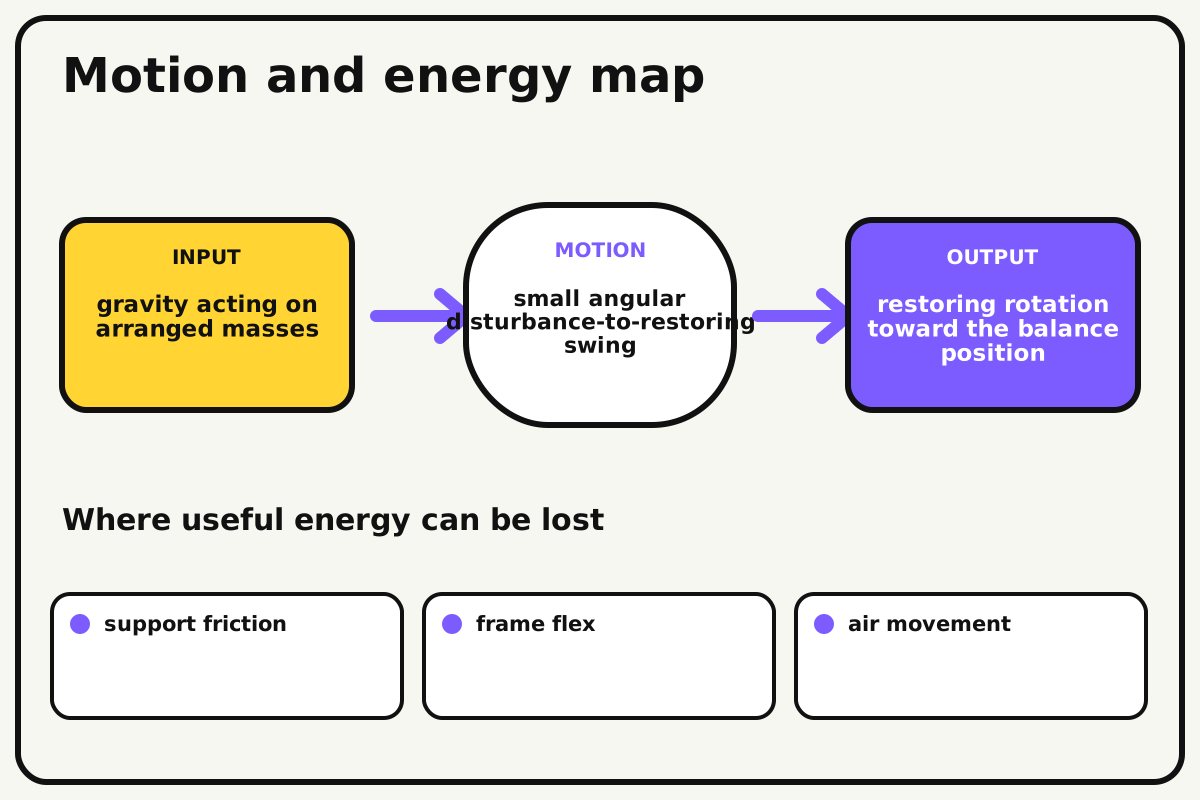
- Input
- gravity acting on arranged masses
- Output
- restoring rotation toward the balance position
- Motion
- small angular disturbance-to-restoring swing
- Energy losses
- support friction, frame flex, air movement, mass shifting
Why this works
Stable equilibrium
When the combined center of mass hangs below the support, a small tilt raises it. Gravity then creates a restoring torque that swings the sculpture back toward its lowest-energy position.
Look for: Shift one equal mass outward and watch how the resting angle changes before adding any new material.
Where the energy goes
Efficiency and losses
The ideal model leaves out support friction, frame flex, air movement, mass shifting. These effects turn some input energy into heat, sound, vibration, or unwanted motion, so measured performance will be lower than an ideal calculation.
Look for: Run the build slowly and locate the first place where support friction becomes visible or audible.
Math bite
Balance two moments
Formula: left mass × left distance = right mass × right distance
- Left = 50 g at 12 cm
- Right mass = 60 g
Substitute: right distance = 50 × 12 / 60 = 10 cm
Result: A 60-gram right mass balances at about 10 cm.
This balances turning moments around the pivot.
The frame and decorations also contribute small moments.
Make it behave
Test, troubleshoot, and tune
Controlled test
Start here: Balance the bare crossbar and two equal masses before adding decoration.
Success looks like: The sculpture balances 30 seconds and returns after a gentle 2 cm displacement.
Measure: Resting angle, oscillation time, mass positions, and support slips.
Change: one mass position
Keep constant: support, crossbar, other mass, room air, release, and timing
- mass at 8 cm
- mass at 10 cm
- mass at 12 cm
| Symptom | Likely cause | Confirm it | Fix |
|---|---|---|---|
| It tips immediately | Center of mass is above or far beside support | Remove decorations and test bare frame | Lower masses and recenter moments |
| It slides off | Pivot notch is shallow or support tilted | Test with no hanging masses | Deepen slightly and level the base |
| It never settles | Support friction is low and air is moving | Turn off fans and time longer | Add a tiny damping paper vane |
| The crossbar bends | Masses are too heavy or far out | View from the side | Reduce mass or reinforce the bar |
Choose your tradeoff
Lower masses improve stable recovery, while moving them outward increases their turning effect and structural demand. Keep decoration light so it remains a design variable rather than hidden ballast.
Keep experimenting
Try another version
Symmetric mobile
Use equal masses at equal distances.
Smallest support
Reduce contact width while maintaining 30-second balance.
Hidden asymmetry
Balance visibly unequal shapes and calculate counter-moments.
Build together
Classroom and access options
Classroom version
Teams can compare one mass position while keeping support, crossbar, other mass, room air, release, and timing. Assign builder, tester, recorder, and explainer roles; have each team predict the result before collecting three trials.
Access adaptations
- Assign varied roles such as designer, builder, tester, recorder, and presenter.
- Provide pre-measured materials and a visual checklist when helpful.
- Use large clips that slide without knots, high-contrast mass labels, and partner roles for holding and observing.
Reflect on the design
- How did one mass position change the measured result?
- Where did support friction affect the build most strongly?
- What evidence shows that stable equilibrium explains the motion?
- Which change would improve restoring rotation toward the balance position without creating a new problem?
Glossary
- Stable equilibrium
- When the combined center of mass hangs below the support, a small tilt raises it.
- Input
- The action or energy supplied to a system; here it is gravity acting on arranged masses.
- Output
- The useful response produced by a system; here it is restoring rotation toward the balance position.
- Efficiency
- The fraction of input energy that becomes useful output instead of friction, sound, heat, or unwanted motion.
Build your dreams
One build can start the next.
Share what you learned, change one variable, and help another builder understand what worked.
Explore more guidesSources and build notes
A common classroom engineering challenge implemented with original constraints, diagrams, and measurement guidance.
- Classroom challenge basis: A controlled-variable engineering activity with original constraints, scoring ideas, and measurement guidance.
Written and edited by BrickLabClips. Published 2026-07-22; updated 2026-07-22.