- Difficulty
- Beginner
- Build time
- 55-85 min
- Estimated cost
- $0-$6
- Age range
- 10-16
- Workspace
- A clear table about 90 cm wide
The finish line
What you will build
The crane lifts 50 grams through 20 cm, rotates the load through a quarter turn, and stays upright throughout the test.
Learning goals
- Identify how hand rotation of a winding drum produces vertical lift at a boom tip.
- Construct and explain a rotary winch-to-linear lift system.
- Measure how the load's horizontal reach changes performance.
- Diagnose losses caused by pulley friction and string rubbing.
Before you build
Materials, tools, and safety
Reuse-material cost: $0-$3 with reused materials. Supervision: Adult help recommended for sharp or heated tools.
Tools
- Ruler
- Pencil
- Scissors
- Masking tape
Low-cost swaps
- Use clean recycled packaging whenever it has similar stiffness.
- Substitute paper clips, binder clips, or twist ties for specialty fasteners.
- Use a thread spool or smooth binder ring instead of a bottle-cap pulley.
Project-specific safety
- Wear eye protection when stretched elastic, magnets, or spinning parts are present.
- Test at floor or tabletop height and keep the path clear of people.
- Lift only small masses over a tray and keep hands away from the suspended-load path.
Orient the build
Place the build so hand rotation of a winding drum is on your left and vertical lift at a boom tip is on your right. Call the side facing you the front, the far side the back, the tabletop the bottom, and the opposite face the top.
Build it
Step-by-step instructions
Step 1
Reinforce the base
Laminate the mast area and add folded feet around the footprint.
Mark the rotation center and front edge.
Step 2
Build the mast
Roll a tight tube and brace it vertically with three triangular gussets.
Check with a square from two directions.
Step 3
Build and tie the boom
Attach the boom near the mast top and add a string tension tie to the rear.
Keep the boom near horizontal.
Builder checkpoint: After build and tie the boom, the first subassembly should stay aligned when handled gently.
Step 4
Make the tip pulley
Pierce the cap center, mount it on a low-friction pin, and add side guards.
Verify string stays in the groove.
Watch for: If this stage binds or drifts, inspect base tipping before adding more parts.
Step 5
Install the winch
Support a pencil drum near the base with an outside crank and stop collar.
Align the string path with the mast.
Step 6
Route and hook the line
Wind neatly, pass over the tip pulley, and attach a closed hook.
Test with an empty paper cup.
Builder checkpoint: After route and hook the line, operate the build slowly and confirm that vertical lift at a boom tip begins without binding.
Step 7
Balance the crane
Add rear mass until the unloaded base stays flat at full boom reach.
Do not exceed the safe counterweight limit.
Step 8
Lift and slew
Raise 50 grams through 20 cm, then rotate the base a quarter turn slowly.
Record base lift, boom deflection, and crank turns.
Builder checkpoint: At the final checkpoint, The crane lifts 50 grams through 20 cm, rotates the load through a quarter turn, and stays upright throughout the test.
See the engineering
Why it works
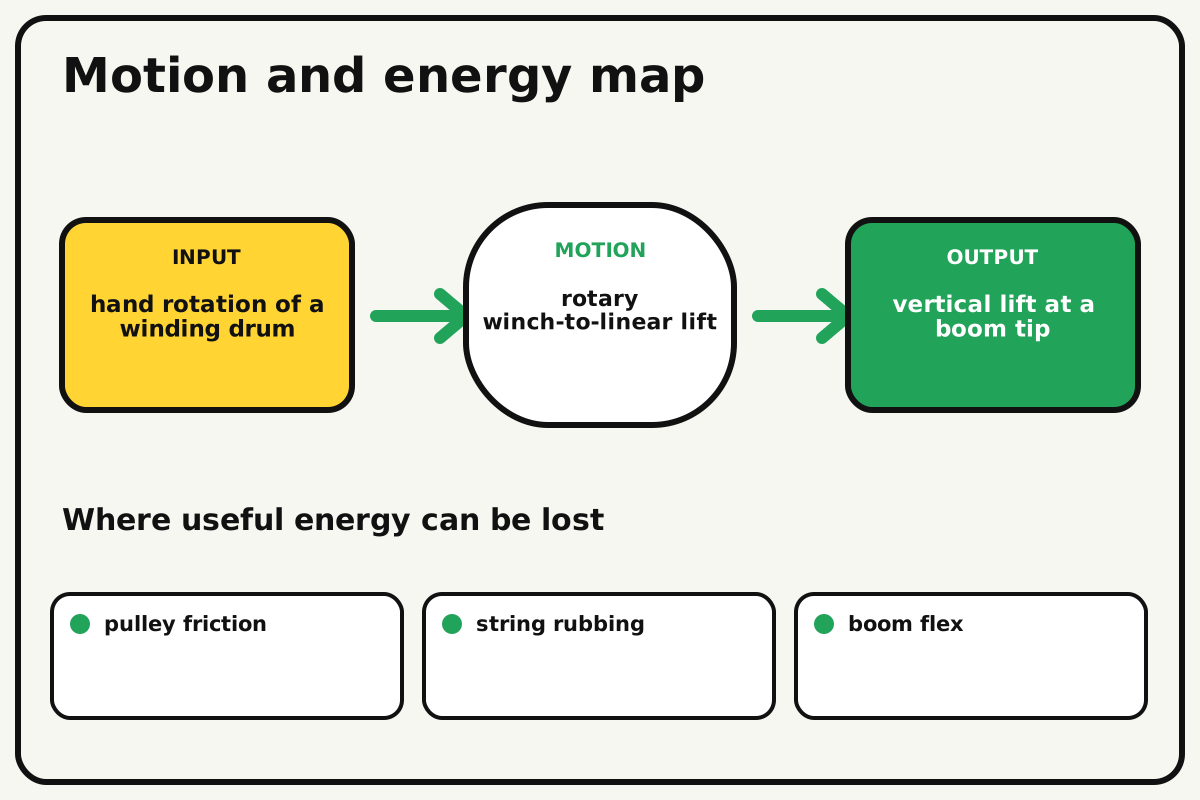
- Input
- hand rotation of a winding drum
- Output
- vertical lift at a boom tip
- Motion
- rotary winch-to-linear lift
- Energy losses
- pulley friction, string rubbing, boom flex, base tipping
Why this works
Crane moment balance
The suspended load creates a tipping moment equal to force times horizontal reach. A broad base, rear counterweight, and tension tie resist that moment while the winch controls height.
Look for: Move the same load closer to and farther from the mast and compare base lifting tendency.
Where the energy goes
Efficiency and losses
The ideal model leaves out pulley friction, string rubbing, boom flex, base tipping. These effects turn some input energy into heat, sound, vibration, or unwanted motion, so measured performance will be lower than an ideal calculation.
Look for: Run the build slowly and locate the first place where pulley friction becomes visible or audible.
Math bite
Compare tipping moments
Formula: moment = force × horizontal distance
- Load force ≈ 0.49 N
- Reach = 0.20 m
Substitute: moment = 0.49 × 0.20 = 0.098 N·m
Result: The load creates about 0.10 newton-metres of tipping moment.
A counterweight farther behind the mast needs less force.
Boom and crane masses also contribute moments.
Make it behave
Test, troubleshoot, and tune
Controlled test
Start here: Lift an empty cup 20 cm before adding weight.
Success looks like: The crane lifts 50 grams, rotates 90 degrees, and keeps every base foot in contact.
Measure: Lift height, boom deflection, and base-foot lift.
Change: the load's horizontal reach
Keep constant: load mass, base, counterweight, string, boom, and lift height
- 10 cm reach
- 15 cm reach
- 20 cm reach
| Symptom | Likely cause | Confirm it | Fix |
|---|---|---|---|
| The crane tips forward | Load moment exceeds base resistance | Watch rear foot during a low load | Reduce reach or add safe rear ballast |
| The boom bends | Section is shallow or tie loose | Measure tip deflection unloaded and loaded | Laminate boom and tension the tie |
| String leaves pulley | Side guards or alignment are poor | Raise empty cup slowly | Add guards and center the line |
| The winch unwinds | No holding method is present | Support load and release briefly | Add a simple ratchet or always hold crank |
Choose your tradeoff
Shorter reach improves capacity and stability but reduces workspace. Strengthen the boom as a deep folded section and use the smallest counterweight that keeps a safe margin.
Keep experimenting
Try another version
Fixed-boom lift
Skip base rotation and lift an empty cup.
Two-part line
Add a moving pulley and compare input force.
Load chart
Graph safe mass versus boom reach.
Build together
Classroom and access options
Classroom version
Teams can compare the load's horizontal reach while keeping load mass, base, counterweight, string, boom, and lift height. Assign builder, tester, recorder, and explainer roles; have each team predict the result before collecting three trials.
Access adaptations
- Offer pre-cut parts and tactile or high-contrast measurement marks.
- Split roles so one builder can hold, another assemble, and another measure.
- Use a large winch handle and a hook with a broad easy-grip tab.
Reflect on the design
- How did the load's horizontal reach change the measured result?
- Where did pulley friction affect the build most strongly?
- What evidence shows that crane moment balance explains the motion?
- Which change would improve vertical lift at a boom tip without creating a new problem?
Glossary
- Crane moment balance
- The suspended load creates a tipping moment equal to force times horizontal reach.
- Input
- The action or energy supplied to a system; here it is hand rotation of a winding drum.
- Output
- The useful response produced by a system; here it is vertical lift at a boom tip.
- Efficiency
- The fraction of input energy that becomes useful output instead of friction, sound, heat, or unwanted motion.
Build your dreams
One build can start the next.
Share what you learned, change one variable, and help another builder understand what worked.
Explore more guidesSources and build notes
A familiar household engineering activity implemented with original instructions and controlled tests.
- Classroom engineering basis: A common educational challenge implemented with original dimensions, tests, diagrams, and instructions.
Written and edited by BrickLabClips. Published 2026-07-22; updated 2026-07-22.
Next builds
Related guides
Pulley Elevator
Raise a small platform with fixed and movable pulleys, then compare input force, rope travel, and mechanical advantage.
Brick-compatible mechanismsBlock-and-Tackle Hoist
Route one rope through fixed and moving pulleys to trade longer pulling distance for lower ideal lifting force.
Classroom challengesMechanical Advantage Lift Challenge
Choose a lever, pulley, wheel-and-axle, or combination system to lift the same load with the smallest measured input force.