
- Difficulty
- Advanced
- Build time
- 120-180 min
- Estimated cost
- $0-$30
- Age range
- 13-18
- Workspace
- A clear table about 90 cm wide
The finish line
What you will build
All planet gears share load without binding, the carrier turns concentrically, and at least two input-hold-output configurations produce different measured ratios.
Learning goals
- Identify how selected rotation of sun, ring, or carrier produces selected concentric member rotation.
- Construct and explain a multi-path rotary-to-rotary system.
- Measure how which member is held changes performance.
- Diagnose losses caused by multiple planet meshes and carrier flex.
Before you build
Materials, tools, and safety
Reuse-material cost: Usually under $5 with an existing kit. Supervision: Adult help recommended for sharp or heated tools.
Tools
- Ruler
- Removable tape for motion marks
Low-cost swaps
- Use equivalent brick-compatible parts from any kit.
- Use cardboard beams and straw bearings for a larger demonstration model.
- Build a large two-dimensional cardboard epicyclic model with pin teeth for qualitative motion only.
Project-specific safety
- Keep fingers, hair, and loose sleeves clear of moving parts.
- Turn the mechanism by hand; do not attach a high-speed motor.
- Turn slowly and use a removable holding handle, keeping fingers outside the ring gear.
Orient the build
Place the build so selected rotation of sun, ring, or carrier is on your left and selected concentric member rotation is on your right. Call the side facing you the front, the far side the back, the tabletop the bottom, and the opposite face the top.
Build it
Step-by-step instructions
Step 1
Build the concentric frame
Support a central axle and ring gear on the same axis.
Check ring roundness at four positions.
Step 2
Mount the sun gear
Secure the sun to its own shaft while allowing the carrier to rotate independently.
Add a visible sun flag.
Step 3
Build the carrier
Place three planet pivots at equal 120-degree spacing and equal radius.
Brace both faces of the carrier.
Builder checkpoint: After build the carrier, the first subassembly should stay aligned when handled gently.
Step 4
Install one planet
Mesh it with sun and ring simultaneously and turn through one orbit section.
Adjust radius before adding others.
Watch for: If this stage binds or drifts, inspect ring-gear rubbing before adding more parts.
Step 5
Install remaining planets
Add equal gears at the other pivots without forcing tooth phase.
Confirm all share similar mesh depth.
Step 6
Add member handles
Provide separate low-speed handles or flags for sun, ring, and carrier.
Add a safe removable ring-hold stop.
Builder checkpoint: After add member handles, operate the build slowly and confirm that selected concentric member rotation begins without binding.
Step 7
Test ring held
Hold the ring, turn the sun slowly, and count carrier movement.
Stop if any planet climbs teeth.
Step 8
Test sun held
Hold the sun, turn the ring, and record carrier motion.
Compare direction and ratio with the first configuration.
Builder checkpoint: At the final checkpoint, All planet gears share load without binding, the carrier turns concentrically, and at least two input-hold-output configurations produce different measured ratios.
See the engineering
Why it works
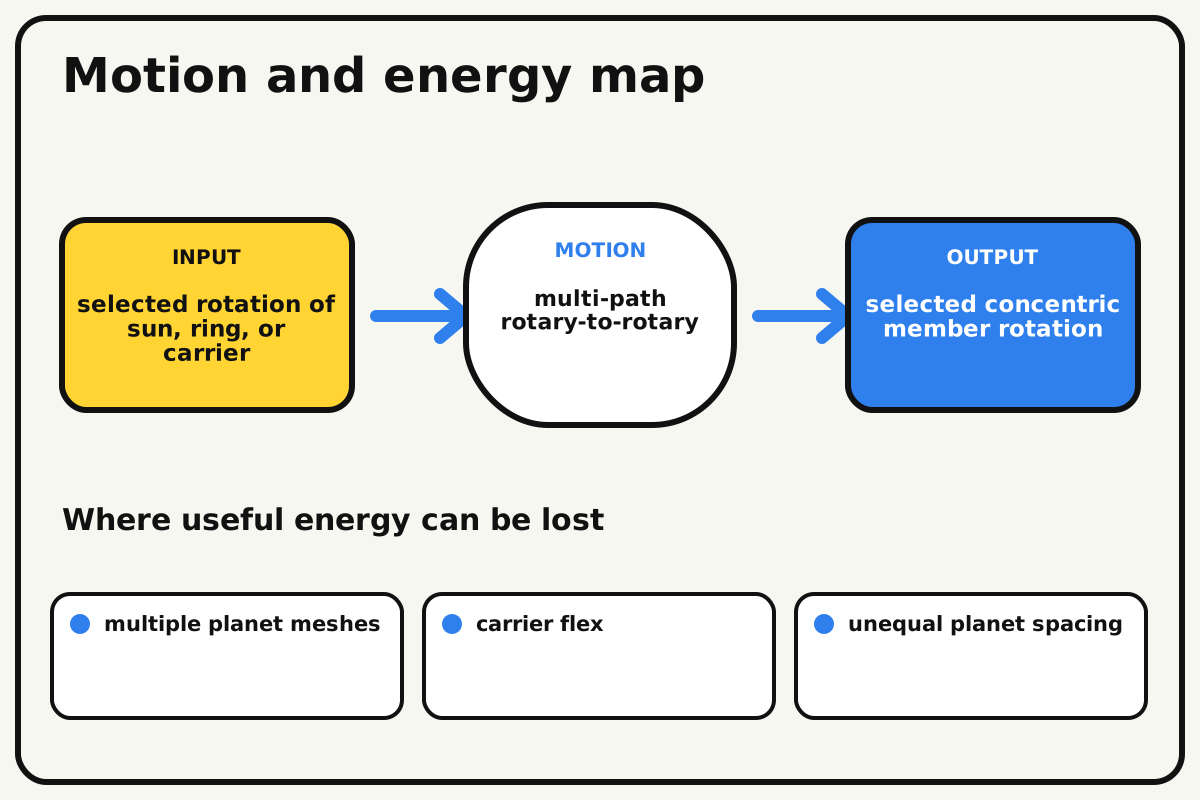
- Input
- selected rotation of sun, ring, or carrier
- Output
- selected concentric member rotation
- Motion
- multi-path rotary-to-rotary
- Energy losses
- multiple planet meshes, carrier flex, unequal planet spacing, ring-gear rubbing
Why this works
Epicyclic gear relationship
Planet gears mesh with both sun and ring while orbiting on a carrier. Relative speeds obey a constraint based on sun and ring tooth counts, so holding one member defines the other two.
Look for: Mark sun, ring, and carrier, then count all three even when one is held at zero.
Where the energy goes
Efficiency and losses
The ideal model leaves out multiple planet meshes, carrier flex, unequal planet spacing, ring-gear rubbing. These effects turn some input energy into heat, sound, vibration, or unwanted motion, so measured performance will be lower than an ideal calculation.
Look for: Run the build slowly and locate the first place where multiple planet meshes becomes visible or audible.
Math bite
Use the planetary constraint
Formula: (ring - carrier)/(sun - carrier) = -sun teeth/ring teeth
- Sun = 12 teeth
- Ring = 36 teeth
- Ring held at 0
Substitute: (0-C)/(S-C) = -12/36, so C = S/4
Result: Four sun turns produce one ideal carrier turn with the ring held.
Different held members create different ratios and directions.
Clearance and planet load sharing affect measured motion.
Make it behave
Test, troubleshoot, and tune
Controlled test
Start here: With the ring safely held, turn the sun four slow rotations.
Success looks like: Planets orbit without binding and the carrier completes about one rotation.
Measure: Sun, ring, and carrier turns in each configuration.
Change: which member is held
Keep constant: gear counts, carrier, frame, turn rate, flags, and zero marks
- ring held
- sun held
- carrier held for direction study
| Symptom | Likely cause | Confirm it | Fix |
|---|---|---|---|
| One planet binds | Its pivot radius or tooth phase differs | Remove other planets and test individually | Match pivot spacing and reseat gear |
| The ring wobbles | Support is not concentric | Rotate ring alone and measure gap to sun | Rebuild concentric bearings |
| Carrier twists | Planet loads are unequal or arms flexible | Hold output lightly and watch carrier face | Brace both sides and match planets |
| Measured ratio is wrong | The held member moves or turns are miscounted | Mark all three and secure the hold stop | Repeat with full rotations from zero |
Choose your tradeoff
Concentricity and equal planet spacing dominate performance. One accurately meshed planet is a better starting point than three forced planets; add load sharing only after the geometry turns freely.
Keep experimenting
Try another version
One-planet model
Explore relative motion before adding load-sharing planets.
Three-member table
Record ratios for each held-member case.
Compound planetary
Add a second sun-ring stage and derive the combined ratio.
Build together
Classroom and access options
Classroom version
Teams can compare which member is held while keeping gear counts, carrier, frame, turn rate, flags, and zero marks. Assign builder, tester, recorder, and explainer roles; have each team predict the result before collecting three trials.
Access adaptations
- Use high-contrast tape to distinguish input and output parts.
- Replace a small crank with a wider handle for an easier grip.
- Use three distinct colors and tactile shapes for sun, ring, and carrier handles.
Reflect on the design
- How did which member is held change the measured result?
- Where did multiple planet meshes affect the build most strongly?
- What evidence shows that epicyclic gear relationship explains the motion?
- Which change would improve selected concentric member rotation without creating a new problem?
Glossary
- Epicyclic gear relationship
- Planet gears mesh with both sun and ring while orbiting on a carrier.
- Input
- The action or energy supplied to a system; here it is selected rotation of sun, ring, or carrier.
- Output
- The useful response produced by a system; here it is selected concentric member rotation.
- Efficiency
- The fraction of input energy that becomes useful output instead of friction, sound, heat, or unwanted motion.
Build your dreams
One build can start the next.
Share what you learned, change one variable, and help another builder understand what worked.
Explore more guidesSources and build notes
An original BrickLabClips interpretation of a standard mechanical mechanism.
- Mechanism verification: Standard kinematics were checked for motion direction, constraint, clearance, and likely friction points.
Written and edited by BrickLabClips. Published 2026-07-22; updated 2026-07-22.
Next builds
Related guides
Open Differential
Split one input between two outputs that can rotate at different speeds while preserving their average speed.
Compound Gear Train
Stack two gear reductions on a shared middle axle to create a large speed change in a compact frame.
Brick-compatible mechanismsTwo-Speed Manual Gearbox
Select between a fast output and a high-reduction output with two permanent gear pairs and a sliding engagement collar.